Podcast: Play in new window | Download (Duration: 33:49 — 19.4MB)
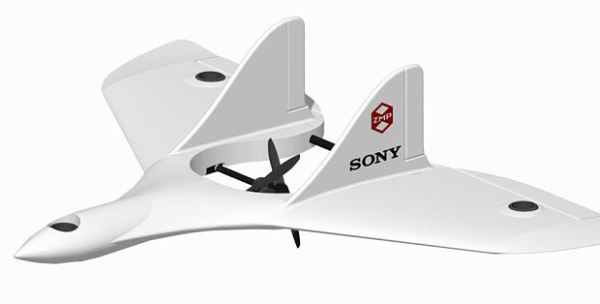
Drone legislation in the news: private property overflights in California, mandatory drone geofencing, and weaponized drones for law enforcement. Also, ALPA responds to pilot encounters with drones, counter-drone systems, and a Sony prototype drone.
News
Drone no-fly zone in California will stifle innovation, say industry advocates
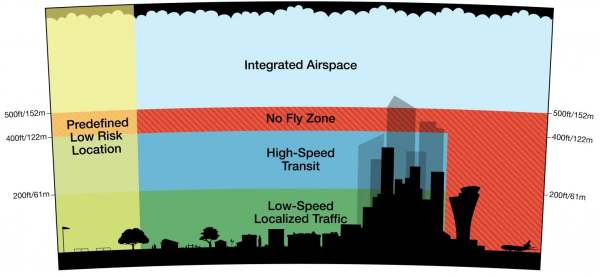
The California Assembly has passed a bill (SB 142) that prohibits flying a drone under 350 feet over private property without permission. The bill is awaiting signature by Governor Jerry Brown and if it becomes law, flying below 350 feet would be considered a trespass violation.
State Senator Hannah-Beth Jackson, who authored the bill said, “People should be able to sit in their backyards and be in their homes without worrying about drones flying right above them or peering in their windows. We need to balance innovation with personal and societal expectations.”
AUVSI Statement on Passage of SB 142 in the California Assembly
Brian Wynne, president and CEO of the Association for Unmanned Vehicle Systems International (AUVSI), released a statement on the passage of SB 142 in the California Assembly. The statement says, in part:
“AUVSI is deeply disappointed with the passage of SB 142 in the California Assembly. While the industry supports the safe, non-intrusive use of UAS technology, SB 142 creates inconsistencies with federal law that has the potential to further confuse UAS users and stifle economic growth in California. The Supreme Court has ruled that property rights do not extend infinitely into the sky. Only the FAA can regulate airspace; states and municipalities can’t.
“The passage of SB 142 is further proof that it is necessary for the FAA to finalize its long awaited rules on small unmanned aircraft. There is much uncertainty about where operators should and shouldn’t fly and for what purpose. For the safety of our skies and to ensure that there is no confusion between state and federal law, we need Washington to make finalizing these rules a top priority.”
ALPA: Airline pilots ‘very concerned’ about UAVs
Air Line Pilots Association (ALPA) president Tim Canoll noted, “pilot reports of unmanned aircraft have increased dramatically over the past year, from a total of 238 sightings in all of 2014 to more than 650 by Aug. 9 of this year.”
With respect to small UAVs operated below the airspace used by commercial aircraft, ALPA advocates: educating operators, using “geo-fencing” to keep small UAVs from operating within 5 mi. of airports, UAV registration at point of sale so owners can be identified after an incident, and “more formalized” enforcement.
For larger UAVs sharing the airspace with airliners, ALPA would like to see FAA regulations and oversight the same as for airliners: operator licensing and collision avoidance technology.
US senator to introduce proposal for mandatory drone geofencing
U.S. Senator Charles Schumer proposed an amendment as part of the FAA Reauthorization Bill that would require manufacturers to implement geofencing on all drones.
Chuck Schumer’s No-Fly-Zone Rule for Drones Won’t Work
At the recent DEF CON hacker conference in Las Vegas, researchers easily defeated the Phantom geofencing. The DJI Phantom III’s geofence uses a database that contains a country, city, a timestamp, and, the latitude and the longitude of the no-fly zones. The hacker downloaded the database and started just changing entries to make the Phantom ignore the no-fly zones set by DJI.
Additionally, some Chinese researchers reported they could disrupt the geofencing through GPS spoofing, which is illegal but not impossible.
Exclusive: U.S. government, police working on counter-drone system – sources
U.S. government agencies are working with state and local police forces to develop protection systems for vulnerable sites. New York police used a microwave-based system last New Year’s Eve in an attempt to track a drone in Times Square. This test was part of a program with the Department of Homeland Security, the FAA, and the Defense Department.
Sony shows off Aerosense camera drone prototype
Sony and ZMP Inc. have formed the joint-venture company AeroSense and they have a prototype drone that can take off and land vertically. Payload capacity is expected to be 22 pounds, with a two hour plus flight time and a top speed of 106 miles an hour. These autonomous drones could be used for infrastructure inspection and land surveys in difficult to access areas.
First State Legalizes Taser Drones for Cops, Thanks to a Lobbyist
Law enforcement in North Dakota can now fly drones with “less than lethal” weapons, such as Tasers, rubber bullets, and tear gas. The original draft of House Bill 1328 actually prohibited weaponization of drones, but a law enforcement lobbyist added language that significantly modified the intent of the bill.
Mentioned
Robots in the Sky: Cracking Down on Drone Law
An infographic highlighting current laws surrounding drone usage, and what changes we may soon see in the future.
Batteries Carried by Airline Passengers: Frequently Asked Questions [PDF]
The FAA describes the kinds of batteries allowed in the cabin, those allowed in checked luggage, how to calculate wattage, and other important information.
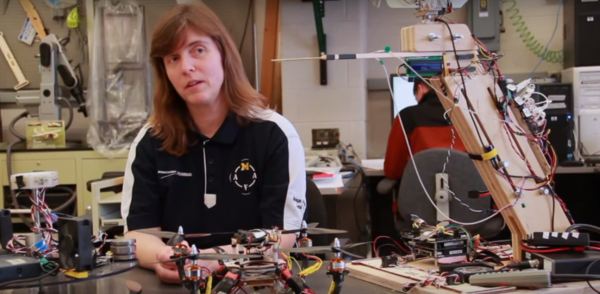
 Ella received her BS and MS in Aeronautics and Astronautics from the Massachusetts Institute of Technology, and her MS and PhD in Computer Science and Engineering from the University of Michigan.
 Dr. Ken Witcher is the dean of the College of Aeronautics. In this role, Ken leads a team of more than 700 active faculty members who support more than 14,000 students enrolled in 15 degree programs. Witcher’s aviation experience includes 20 years of service in the United States Air Force. During this time, he served as superintendent of an operational test and evaluation squadron and field training detachment chief for F-15, F-16, F-22, H-60, A-10, MQ-1, and MQ-9 aircraft and supporting systems. He also served as a team member of the United States Air Force Air Demonstration Squadron, Thunderbirds. Witcher was an appointed member of the Nevada UAS test site selection panel and previously served as Chair of the Nevada Aerospace and Defense Sector Council reporting directly to the Governor’s Workforce Investment Board. Reach Dr. Witcher at
  David Thirtyacre is an assistant professor and chair of unmanned flight operations in the College of Aeronautics. He has a bachelor’s degree in mechanical engineering, master’s degree in aerospace science, and is currently a doctoral student in aviation at Embry-Riddle’s Daytona Beach campus. Thirtyacre recently retired from the U.S. Air Force with 27 years of duty in the fighter community and over 3,500 hours in fighter aircraft. He spent the last 17 years of his career at Nellis Air Force Base in Las Vegas and served as an operational test pilot and director of advanced programs at the U.S. Air Force Warfare Center. In this role, he was the point person for advanced program operational planning; and the integration of air, space, and cyberspace domains with fifth-generation aircraft, unmanned systems, national capabilities, and other Department of Defense assets. Additionally, he is a multi-engine commercial pilot and certified flight instructor – instrument. Reach David Thirtyacre at
  Stefan Kleinke is an assistant professor and program chair for the Bachelor of Science in Unmanned Systems Application (BSUSA) degree program in the College of Aeronautics. Stefan earned a Master of Aeronautical Science degree from Embry-Riddle Worldwide in 2010 and is a military aviation veteran with 15 years and 3,000 total flying hours experience as pilot and instructor on Tornado and T-38 jet aircraft. In this role, he was heavily involved in student and instructor training, standardization and evaluation, and aspects of air traffic control and airfield management. He also holds civilian qualifications that include Airline Transport Pilot License, Commercial Pilot License for helicopter and seaplane, Airframe and Powerplant Mechanic and Aircraft Electrical Technician certifications, as well as FCC GMDSS Radio Operator and Maintainer license with Ship Radar Endorsement. Reach Stefan Kleinke at
 ![NASA UTM Chart]](http://utm.arc.nasa.gov/images/utm-chart.png)